![]() |
|
|||
|
September 07, 2008
Note: Adobe Acrobat Reader required for PDF documents.
Last Updated: November 15, 2006 |
|
|||
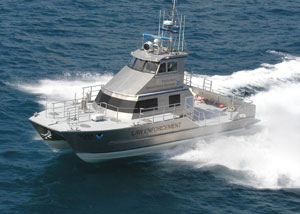
HistoryThe Florida Keys National Marine Sanctuary was established in 1990 under legislation laid out in the National Marine Sanctuary Act of 1972 and following the earlier designation of the Key Largo and Looe Key National Marine Sanctuaries in 1975 and 1981. The regulations established in the Final Management Plan for the Florida Keys National Marine Sanctuary came into effect in 1997. As part of the FKNMS Final Management Plan, provisions were made for the enforcement of Sanctuary Regulations under an Enforcement Action Plan. Law Enforcement in the Florida Keys National Marine Sanctuary is a cooperative partnership between the National Oceanic and Atmospheric Administration (NOAA) the State of Florida, Florida Fish and Wildlife Conservation Commission (FWC) and is carried out by the FKNMS Law Enforcement Team. How does the FKNMS Law Enforcement Program work?NOAAs primary law enforcement objective in the Sanctuary is to achieve resource protection by gaining compliance with the sanctuary regulations and other Federal and State statutes that apply within the FKNMS. NOAA is also concerned with effective enforcement of all Federal, State, and local statutes that protect the natural, cultural, and historical resources with the Florida Keys National Marine Sanctuary FKNMS Law Enforcement PhilosophyThe law enforcement program of the Florida Keys National Marine Sanctuary (FKNMS) is an essential component of resource protection and boating safety with the Sanctuary. The goal of Sanctuary Law Enforcement is to educate boaters and enforce Federal and State laws regarding boating safety, resource protection and Sanctuary regulations. These education and enforcement efforts are best achieved by maintaining patrols throughout the Florida Keys National Marine Sanctuary. Officers with the FKNMS routinely patrol from Key Largo to the Dry Tortugas, in both State of Florida and Federal waters. These routine patrols provide quick response to violations or emergencies. All Sanctuary officers are Florida State Law Enforcement Officers with the authority to investigate, document, and assess civil or criminal penalties for violations of Federal, State, County or City laws or ordinances under Florida Statute 370.021(8)(a) Integrating Enforcement EffortsAcross the United States, Federal, State, and local agencies are increasingly joining forces and targeting whole coastal ecosystems including rivers, bays, estuaries, and coastlines for comprehensive management and enforcement actions. Federal, State, and local laws provide government agencies with a variety of tools to protect coastal resources. In so doing, these laws strengthen law enforcement capabilities by allowing agencies to build on each others expertise and share physical resources. Federal, State, and local agencies in the Keys are implementing this process of integrating efforts. In addition, local residents and frequent Sanctuary users are helping by detecting and reporting various violations and groundings, monitoring water quality, and submitting witness statement forms that document Sanctuary violations Challenges to FKNMS EnforcementVarious Aspects of the Florida Keys National Marine Sanctuary result in numerous challenges to enforcement. Some of these challenges include:
Successes In Sanctuary EnforcementGaining compliance is a continuous challenge. Despite the challenges there have been many successes in Sanctuary enforcement.
Gaining ComplianceEducation and outreach are primary management objectives that are targeted at getting information out to the public regarding Sanctuary regulations and other pertinent information. The goal is to have a knowledgeable and well-informed public who are the primary users of Sanctuary resources. Over the years, personal observations have revealed that the majority of the general public is environmentally alert, aware and concerned. They will comply with resource laws if they are aware of them and will not intentionally break the laws. A small percentage of the public will not go out of their way to learn or obtain information about resource laws. They will go about their business of recreating themselves, until they encounter a law enforcement officer. Very few members of the public go about their business and pay no attention to resource laws and fail to obey them. These few members are those that gamble on the slim chance of being caught. They rely on the vastness of the ocean and their ability to see the officers approaching. They conclude that it is part of the cost of doing business. They don't care. These are the types of persons that make law enforcement programs necessary. It is critical to have enforcement programs in place to firmly and decisively prosecute these violators. If these violations are not addressed they will erode the general compliance from the other groups mentioned and create a general attitude of complacency among all of those persons utilizing the resources of the Florida Keys for commercial or recreational purposes Officers and VesselsThe FKNMS Law Enforcement Team is comprised of:
Major Enforcement Initiatives |